Anomaly detection (AD) aims to identify defects using normal-only training data. Existing anomaly detection benchmarks (e.g., MVTec-AD with 15 categories) cover only a narrow range of categories, limiting the evaluation of cross-context generalization and scalability.
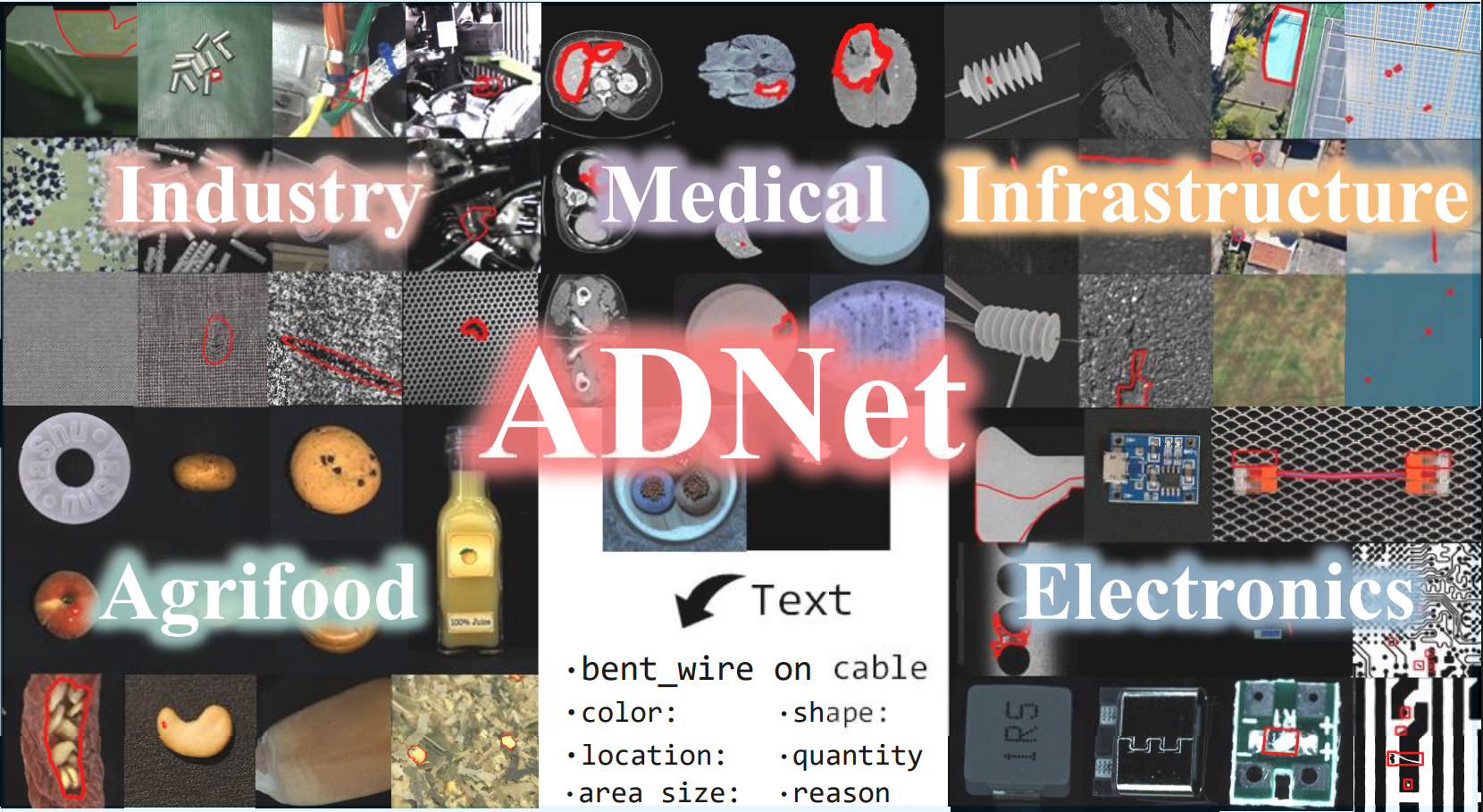
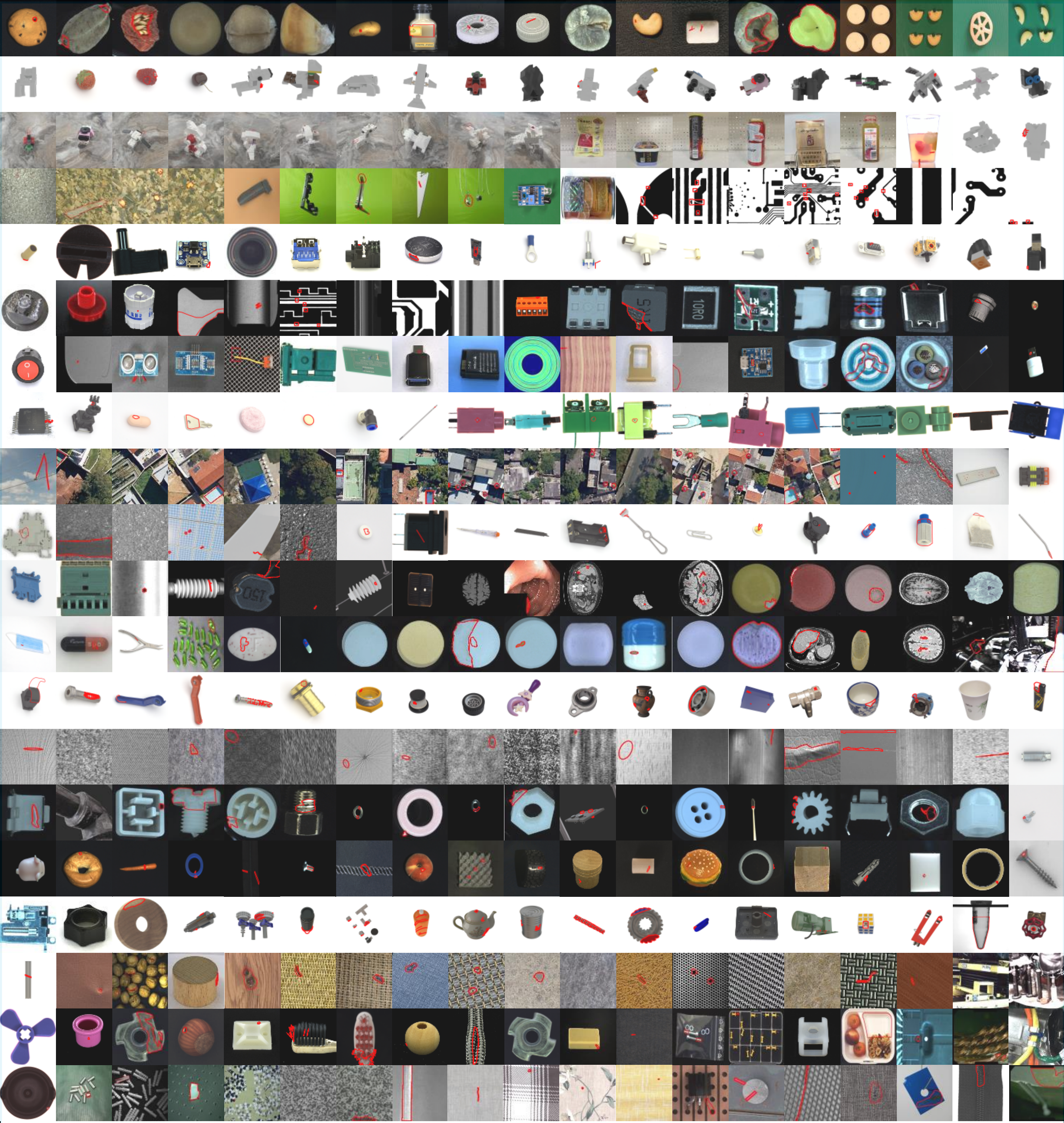
We introduce ADNet, a large-scale, multi-domain benchmark comprising 380 categories aggregated from 49 publicly available datasets across Electronics, Industry, Agrifood, Infrastructure, and Medical domains. The benchmark includes a total of 196,294 RGB images, consisting of 116,192 normal samples for training and 80,102 test images, of which 60,311 are anomalous. All images are standardized with MVTec-style pixel-level annotations, and anomalous samples are further enriched with structured text descriptions spanning both spatial and visual attributes, enabling multimodal anomaly detection tasks.
Extensive experiments reveal a clear scalability challenge: existing state-of-the-art methods achieve 90.6% I-AUROC in one-for-one settings but drop to 78.5% when scaling to all 380 categories in a multi-class setting.
To this end, we propose Dinomalym, a context-guided Mixture-of-Experts extension of Dinomaly that forms image-conditioned decoder feed-forward networks through convex combinations of expert parameter banks. It achieves 83.2% I-AUROC and 93.1% P-AUROC, outperforming existing approaches while maintaining measured latency close to vanilla Dinomaly.
We aim to make ADNet a standardized and extensible benchmark, supporting the community in expanding anomaly detection datasets across diverse domains and providing a scalable foundation for AD foundation models. Dataset: https://grainnet.github.io/ADNet.